
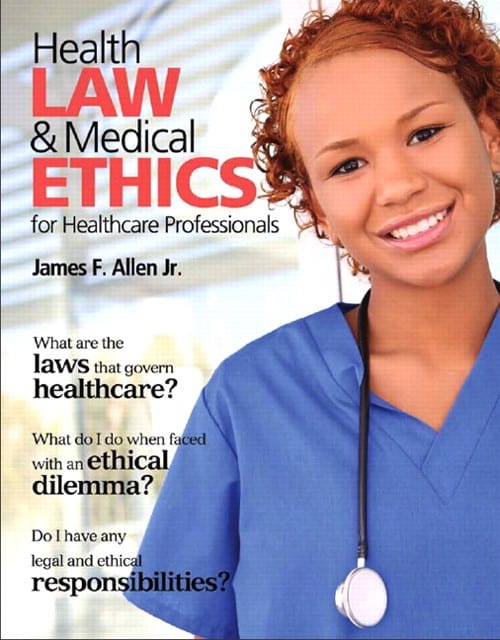
Health Law and Medical Ethics

Health Law and Medical Ethics

Price: $105.99
The Health Law and Medical Ethics is today’s most effective introduction to health law and medical ethics.

Shopping with us is fast, easy, and affordable

Free Shipping Available on $250+ Orders
Buy Confidently with our Hassle-Free Returns
Sales Suport Available 1-800-952-0910
Book Overview

The Health Law and Medical Ethics is the only book of its kind, it combines a visual, engaging, and modern design with scrupulous accuracy about the law, reflecting the author’s experience as a legal professional. It addresses the most recent trends in law and ethics, treating both areas with equal depth and insight, and demonstrating their deep interconnections. Coverage includes: how the law works; responsibilities of healthcare professionals; medical records, insurance, torts, and negligence; ethical decision-making; the beginning and end of life; bioethics; the future of healthcare; issues associated with diversity, and much more. Pedagogical features include many case studies and case analyses, Legal Alert and “Concept Application” boxes, discussion questions, and a glossary.


Key aspects:

  • Regulation of Healthcare Delivery
    Covers the laws, policies, and standards that govern how healthcare organizations and professionals operate.
  • Patient Rights and Protections
    Includes informed consent, privacy and confidentiality (e.g., HIPAA), and the right to refuse or choose treatment.
  • Professional Liability and Accountability
    Addresses malpractice, negligence, and the legal responsibilities of healthcare providers.
  • Decision-Making Capacity and Consent
    Focuses on determining whether patients can make their own medical decisions and ensuring ethical consent processes.
  • Ethical Principles in Medicine
    Grounded in autonomy, beneficence, nonmaleficence, and justice as guiding moral values for clinical practice.
  • Resource Allocation and Public Health
    Looks at how limited medical resources are distributed and how public health policies balance individual rights with community safety.
  • Bioethical Issues and Emerging Technologies
    Examines challenges related to genetics, reproductive technologies, end-of-life care, artificial intelligence in medicine, and other innovations.

Highlights:

  • Ensures that legal rules and ethical standards work together to guide healthcare practice.
  • Protects patient welfare, dignity, and autonomy in all medical interactions.
  • Helps resolve complex moral dilemmas, especially in rapidly advancing areas of medicine.
  • Provides a framework for ethical decision-making in hospitals, clinics, and public health settings.
  • Balances professional responsibility with legal accountability for healthcare providers.

Key Features & Benefits

Product Checkbox
Comprehensive Coverage:

The Health Law and Medical Ethics provides a broad and integrated framework that governs every aspect of healthcare practice, from clinical decision-making to institutional policy. This field covers regulatory standards for healthcare organizations, professional licensure, and provider accountability while also safeguarding patient rights such as informed consent, privacy, and equitable access to care. It examines the ethical foundations of medical practice—autonomy, beneficence, nonmaleficence, and justice—and applies them to real-world challenges involving treatment decisions, end-of-life care, reproductive issues, medical research, and emerging technologies. Comprehensive coverage also includes public health law, addressing government authority in disease control, health promotion, and emergency response. Malpractice law, risk management, and ethical dilemmas surrounding scarce resource allocation are central components as well. Together, these legal and ethical frameworks ensure that healthcare systems operate responsibly, transparently, and with a consistent focus on patient safety, fairness, and moral integrity.

Legal Foundations

  • Regulatory standards for hospitals, clinics, and healthcare systems
  • Professional licensure and scope-of-practice requirements
  • Malpractice law and provider liability
  • Patient protections under federal and state law (e.g., privacy, consent)

Ethical Principles

  • Autonomy: honoring patient choice and self-determination
  • Beneficence: promoting patient well-being
  • Nonmaleficence: avoiding harm
  • Justice: ensuring fairness in treatment and access

Clinical and Institutional Issues

  • Informed consent and disclosure requirements
  • Decision-making capacity and substitute decision-making
  • Confidentiality and ethical handling of patient information
  • Risk management and quality assurance in healthcare settings

Public Health and Policy

  • Disease prevention and control policies
  • Government authority during health emergencies
  • Ethics of vaccination, quarantine, and public health mandates
  • Community health equity and resource distribution

Bioethical and Emerging Issues

  • End-of-life decisions, palliative care, and advanced directives
  • Reproductive ethics, genetic testing, and fertility technologies
  • Artificial intelligence, digital health, and data ethics
  • Ethical challenges in human subjects research and clinical trials
Product Checkbox
Practical Application:

The Health Law and Medical Ethics ensures that legal requirements and ethical principles are actively integrated into everyday healthcare practice. Clinicians use these guidelines to obtain informed consent, maintain confidentiality, and make treatment decisions that respect patient autonomy while prioritizing safety and well-being. Healthcare institutions rely on legal and ethical standards to develop policies on patient care, risk management, and professional conduct, ensuring consistency and accountability across all departments. In complex situations—such as end-of-life decisions, allocation of limited resources, handling medical errors, or interpreting advance directives—providers use ethical frameworks and legal directives to make decisions that are fair, transparent, and defensible. Public health agencies also apply these principles when designing community-based interventions, creating emergency response strategies, or balancing individual rights against population health needs. Overall, the practical application of health law and medical ethics ensures that healthcare delivery remains lawful, ethical, patient-centered, and socially responsible.

Clinical Practice

  • Obtaining informed consent in a clear, understandable manner
  • Assessing patient decision-making capacity
  • Ensuring privacy and confidentiality during care
  • Documenting and disclosing medical errors ethically and legally

Healthcare Institutions

  • Creating and enforcing policies on patient safety, infection control, and quality improvement
  • Managing risk and preventing malpractice through training and oversight
  • Handling ethical consultations and resolving conflicts between patients, families, and providers
  • Ensuring equitable access to services and preventing discrimination

End-of-Life and Complex Decisions

  • Interpreting and applying advance directives and living wills
  • Use of ethics committees to support difficult treatment decisions
  • Determining appropriate use of life-sustaining treatments or palliative care
  • Balancing patient wishes with clinical judgment and legal constraints

Public Health Practice

  • Developing health policies that protect communities while respecting civil liberties
  • Implementing vaccination programs, quarantine measures, and emergency responses ethically
  • Monitoring and addressing health disparities using legal and ethical guidelines
  • Communicating public health risks truthfully and responsibly

Emerging Technologies and Research

  • Ensuring ethical use of AI, telemedicine, and digital health tools
  • Protecting patient data in electronic records and digital platforms
  • Regulating research involving human subjects
  • Addressing ethical issues in genetics, reproductive technologies, and biotechnology
Product Checkbox
Licensing Exam Preparation:

The Health Law and Medical Ethics helps prepare you for a licensing exam by giving you a clear understanding of the legal and ethical standards that govern healthcare practice, which are heavily tested on most licensure exams. These books explain essential topics such as patient rights, informed consent, confidentiality, HIPAA, professional liability, malpractice, and the proper way to document and report information—areas that commonly appear in exam questions. They also strengthen your ability to think through ethical dilemmas by teaching core principles like autonomy, beneficence, non-maleficence, and justice, which helps you answer case-based or scenario questions that require professional judgment. In addition, these textbooks show how the legal system applies to real clinical settings, helping you understand concepts like standard of care and how to avoid legal risk, which licensing boards expect practitioners to know. Many of these books also include review questions, case studies, and practice scenarios that mimic the structure of licensure exams, giving you an opportunity to test your knowledge and build confidence. Overall, they provide both the foundational content and the reasoning skills necessary to succeed on the legal and ethical components of your licensing examination.

  • Provides clear explanations of key legal topics such as patient rights, informed consent, confidentiality, HIPAA, malpractice, and scope of practice—subjects frequently tested on licensing exams.
  • Strengthens ethical reasoning by teaching principles like autonomy, beneficence, non-maleficence, and justice, which helps you answer scenario-based or judgment-based exam questions.
  • Connects legal concepts to real clinical situations, helping you understand how laws, regulations, and standards of care apply in practice.
  • Includes practice questions, case studies, and exam-style scenarios that let you test your knowledge and prepare for the types of questions seen on licensing exams.
  • Reinforces professional responsibilities, ethical conduct, and legal duties expected by licensing boards, ensuring you meet the standards required to pass the exam.
Product Checkbox
Visual & Organizational Tools:

The Health Law and Medical Ethics uses visual and organizational tools to make complex legal and ethical information more accessible and easier to retain. These tools often include charts, tables, diagrams, and flowcharts that illustrate relationships between laws, regulations, and ethical principles, or outline step-by-step processes such as reporting requirements or consent procedures. Case summaries and boxed highlights are used to organize real-world scenarios, emphasizing key facts, legal issues, decisions, and outcomes. Additionally, headings, subheadings, bullet points, and numbered lists break down large amounts of information into manageable sections, making it easier for students to navigate the material and focus on concepts most likely to appear on licensing exams. By combining visual aids with structured organization, the book enhances comprehension, reinforces memory, and streamlines review for exam preparation.

  • Charts and Tables: Compare laws, ethical principles, or regulations for easy reference.
  • Diagrams and Flowcharts: Illustrate processes such as consent, reporting, or legal procedures.
  • Case Summaries/Boxed Examples: Highlight real-world scenarios with key facts, legal issues, and outcomes.
  • Headings and Subheadings: Organize content into clear, logical sections for easier navigation.
  • Bullet Points and Numbered Lists: Break down dense information into digestible pieces.
  • Highlight Boxes/Callouts: Emphasize important definitions, statutes, or ethical principles.
  • Integrated Visuals with Text: Enhance comprehension and aid in memory retention for exam preparation.
Publisher Information

James F. Allen Jr., the author of Health Law & Medical Ethics for Healthcare Professionals, holds multiple professional credentials, including RN (Registered Nurse), BSN (Bachelor of Science in Nursing), MBA/HCM (Master of Business Administration in Healthcare Management), and JD (Juris Doctor).

Book Details
  • Publisher: Prentice Hall PTR
  • Edition/Release Date: 1st Edition, February 17th, 2012
  • ISBN: 9780135027998
  • Pages: 264
  • Dimensions: 8.5 x 10.9 inches
  • Format: Paperback / Softbound
  • Target Audience: Professionals
Pricing & Purchase Information

• Price: $105.99
• Shipping: Free shipping on orders over $250.
• Formats Available: Physical Book

Related Products

Ensure you and your team are up-to-date with the latest Health Law and Medical Ethics and stay compliant with ease.

Click below to order your copy of Health Law and Medical Ethics today!