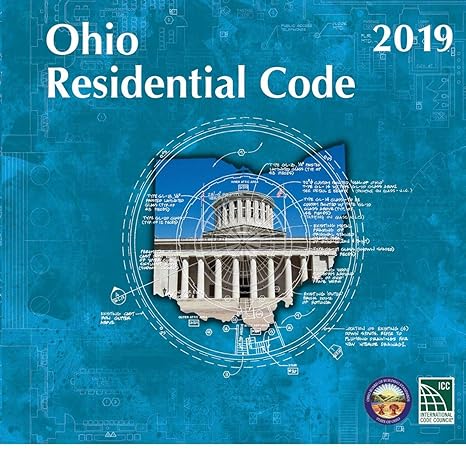
Ohio Residential Code – 2019

Ohio Residential Code – 2019

Book Overview
The Ohio Residential Code – 2019 is the state‑adopted regulatory code governing the design, erection, alteration, repair, and maintenance of one‑, two‑ and three‑family dwellings and townhouses (up to three stories) in Ohio. Effective July 1, 2019, it is based on the 2018 International Residential Code (IRC) with specific Ohio‑amendments adopted by the Ohio Board of Building Standards. The purpose of the code is to protect the public health, safety and general welfare by establishing minimum requirements for structural integrity, fire and life‑safety, sanitation, ventilation, energy conservation and light in these residential buildings. The code covers a broad spectrum of topics — from foundations, framing, and exterior envelope, to mechanical, plumbing and electrical aspects as they relate to the residential construction context (either directly or by cross‑reference). The code also integrates Ohio‑specific By providing a singular statewide reference for residential construction, the 2019 RCO promotes uniformity in enforcement and helps local jurisdictions adopt consistent permitting, inspection, and plan‑review processes. The code is leveraged by builders, designers, inspectors and local building departments to ensure dwellings meet minimum performance and safety standards before occupancy.
Key aspects:
- Adoption of the 2018 IRC as the base model for the Ohio code update.
- Incorporation of the 2018 International Energy Conservation Code (IECC) for one‑, two‑ and three‑family dwellings into the RCO, elevating energy‑efficiency requirements for the building envelope, insulation, fenestration, and air‑leakage.
- Revised envelope insulation requirements (such as basement/crawl space walls and ceiling/attic insulation) aligned across Ohio’s climate zones under the energy provisions.
- Specific allowance for buried ducts in ceiling insulation, provided that the ceiling insulation above ducts is R‑19 or greater.
- Adjusted insulation/thermal envelope U‑factor and R‑value requirements to reflect Ohio’s amendments.
- The RCO streamlines statewide adoption and enforcement, promoting uniformity across jurisdictions in Ohio, rather than each locality having separate residential codes.
Highlights:
- Effective Date: It became effective across Ohio on July 1, 2019.
- Uniform Statewide Enforcement: By adopting a state‑wide code (with local certification of departments), the RCO aims to create consistent enforcement and regulatory framework across all jurisdictions in Ohio.
- Amendments for Ohio Conditions: The code includes modifications and deletions of sections from the model code to align with Ohio’s climatic, geographic, and construction practice realities.
Key Features & Benefits
The Ohio Residential Code – 2019 is the state‑adopted regulatory code governing the design, erection, alteration, repair, and maintenance of one‑, two‑ and three‑family dwellings and townhouses (up to three stories) in Ohio. Effective July 1, 2019, it is based on the 2018 International Residential Code (IRC) with specific Ohio‑amendments adopted by the Ohio Board of Building Standards. The purpose of the code is to protect the public health, safety and general welfare by establishing minimum requirements for structural integrity, fire and life‑safety, sanitation, ventilation, energy conservation and light in these residential buildings. The code covers a broad spectrum of topics — from foundations, framing, and exterior envelope, to mechanical, plumbing and electrical aspects as they relate to the residential construction context (either directly or by cross‑reference). The code also integrates Ohio‑specific amendments to adjust for local conditions, enforceability, and administrative procedures. By providing a singular statewide reference for residential construction, the 2019 RCO promotes uniformity in enforcement and helps local jurisdictions adopt consistent permitting, inspection, and plan‑review processes.
- Adoption & Basis: The 2019 RCO is derived from the 2018 International Residential Code (IRC) with Ohio‑specific amendments made by the Ohio Board of Building Standards.
- Scope: The code applies to one‑, two‑ and three‑family dwellings and townhouses (up to three stories) in Ohio.
- Purpose: To set minimum standards for design, construction, alteration, repair, and maintenance of dwellings — addressing structural integrity, fire safety, sanitation, light & ventilation, energy conservation, and other health & welfare concerns.
- Energy Efficiency Integration: The 2019 RCO incorporates provisions of the 2018 International Energy Conservation Code (IECC) for residential buildings, giving greater emphasis on energy performance, blower‑door testing, and efficiency of building envelope components.
The Ohio Residential Code – 2019 serves as the legal baseline that contractors, designers, building officials, and homeowners rely on when constructing, altering, repairing or maintaining one‑, two‑ or three‑family dwellings (and townhouses up to three stories) in Ohio. For example, during a new home build, the framing, envelope insulation, means of egress, stair dimensions, required fire protection, and energy‑conservation features must all meet the requirements laid out in the RCO. Building departments review plans and issue permits based on its chapters; inspections are conducted to verify that work complies with the code. If a homeowner finishes a basement or adds a deck, compliance with sections on ceilings, guardrails, structural loads, moisture control, ventilation, and energy efficiency is required. The code is also referenced when local jurisdictions enforce uniform statewide standards, enabling consistent interpretation and enforcement across municipalities.
- Permit review: Building departments verify that submitted plans comply with RCO chapters (structure, insulation, egress, fire safety, etc.).
- Inspection checkpoints: At framing, drywall, final stages, inspectors check that work aligns with structural and energy provisions in the RCO.
- Energy compliance: Builders confirm that insulation, fenestration, and HVAC meet the RCO’s energy‑related criteria (e.g., via referenced IECC provisions).
- Alterations & remodels: When modifying an existing dwelling (basements, additions, decks), the applicable RCO sections guide required minimums even for changes.
- Guardrails, stairs & egress: The RCO specifies dimensions, guard heights and opening limitations (e.g., a 4‑in sphere rule for guards) which must be followed on decks, stairs and porches.
- Consistent statewide enforcement: The RCO provides a standard framework so that whether you’re building in Columbus or Dayton you’re subject to the same statewide baseline.
When studying for a licensing exam that references the Ohio Residential Code – 2019, it’s important to combine code‑book familiarity with practical problem‑solving skills. Start by obtaining the official code book (or digital version) and tabbing the chapters that most frequently come up in exams (e.g., structural, energy, means of egress, fire‑safety, and definitions). Practice locating specific tables, chapters or provisions quickly, because many open‐book exams test not only knowledge of content but also how fast you can find it. Supplement your reading with practice questions, mock exams and exam‑style scenarios—these help you get used to the question format and make you aware of tricky wording. Focus on Ohio‑specific amendments (because the RCO is the 2019 IRC base with Ohio modifications), so you’re not caught off‑guard by jurisdictional nuances. Finally, allow time for review of calculations (for example energy/insulation U‑factors, opening sizes, stair/guard dimensions) and cross‐referencing among chapters: building code exams often require you to know which chapter governs a condition or which table applies.
- Get the latest RCO book (2019 edition) and tab key chapters: structural, fire protection, means of egress, energy, definitions/terms.
- Familiarize yourself with chapter indexes & tables—practice “find this requirement” drills.
- Focus on Ohio‑amendments: know which provisions have been modified/deleted from the base IRC.
- Use practice questions or simulated exams to get comfortable with timing and format.
- Review calculations and tables: for example, insulation R‑values, stair/tread/run dimensions, guard opening limits, fire‐rating times.
- Develop “lookup skills” for open‐book format: know which chapter governs a given scenario.
- Study definitions and terminology—many exam questions hinge on subtle wording distinctions.
- Revisit common inspection/permit scenarios: decks, basements, egress windows, insulation, smoke/CO alarms—these often appear in questions.
- Ensure you meet any experience or continuing education prerequisites for your exam level (especially for code officials) as set in Rules like Rule 4101:7‑3‑01.
- Schedule your study over a realistic timeline—don’t cram everything last minute.
The Ohio Residential Code – 2019 is designed with a clear and logical organizational structure to facilitate easy navigation and practical use by contractors, inspectors, and building officials. The code is divided into well-defined chapters covering different aspects of residential construction, such as administration, definitions, building planning, and energy conservation. To aid users, the code includes detailed tables of contents and chapter headings that allow quick access to relevant sections. Visual aids like flowcharts and diagrams are incorporated to illustrate processes such as enforcement pathways and inspection sequences. The digital version of the code enhances usability further by providing interactive features like hyperlinked sections, bookmarks, and searchable content, enabling rapid lookup of specific requirements. Additionally, Ohio-specific amendments are clearly annotated within the text, highlighting modifications from the base 2018 International Residential Code, which helps users understand state-specific regulations without confusion. Throughout the code, consistent formatting, bold headings, and well-organized tables summarize complex data—such as insulation R-values or means of egress dimensions—making the document both comprehensive and practical for field use. These visual and organizational tools combine to ensure that users can efficiently interpret, apply, and enforce the code’s provisions statewide.
Book Details
- Publisher: International Code Council
- Edition/Release Date: 2019, June 13, 2019
- ISBN: 9781609839055
- Pages: 638
- Dimensions: 8.5x 11 inches
- Format: Paperback / Softbound
- Target Audience: Professionals
Pricing & Purchase Information
• Price: $153.99
• Shipping: Free shipping on orders over $250.
• Formats Available: Physical Book
Related Products