
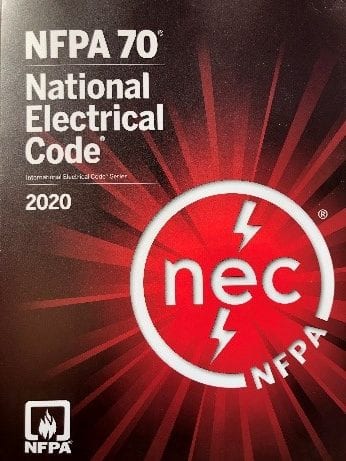
NFPA 70 National Electrical Code (NEC) – 2020 Edition

NFPA 70 National Electrical Code (NEC) – 2020 Edition

Book Overview
Changes to the 2020 edition of NFPA 70®, National Electrical Code® (NEC®), include:
- Added, edited, and reorganized content to address safety for workers, energy systems and electric vehicles, limited energy, and communication systems
- Revisions to service disconnect rules to help protect electrical workers from arc flash hazards
- Adapted and adjusted requirements for installation practices of new technologies to meet the evolving demand for Power over Ethernet
- Updates to modernize tables currently in use for calculations to reflect improvements in energy efficiency and align with evolving codes
- Revised requirements for ground-fault protection within marinas and boatyards
- Introduction of guidelines for the safe use of electric vehicles (electric vehicle power export equipment) as a backup or emergency power source for a building or a home
- Reorganization of Article 310, including new user-friendly numbering for important ampacity tables, a new definition for cable bundle in Article 725, and more!
The NEC, 2020 edition, introduces significant new requirements for:
- Exterior emergency disconnects of one- and two-family dwellings for improved electrical safety for emergency responders
- The residential installation of receptacle outlets serving island and peninsular countertops and for surge protection of services supplying dwelling units
- Working space for “housekeeping pads” for electrical equipment, the installation of wiring methods in exit enclosures, sizing supply and load conductors used with adjustable-speed drive systems, and AFCI protection of branch circuits in patient sleeping areas in care facilities
- Calculating the load of electric vehicle supply equipment with variable current settings
- Worker safety in identifying the source of power for disconnecting means and for egress from spaces containing large electrical equipment
- Grounding of disconnecting means installed on the supply-side of service disconnecting means
- Cables installed exposed on ceiling surfaces and sidewalls
- Special occupancies, special equipment, and special conditions, including installation of splash pads, the use of “Type P” cables in hazardous classified locations, and the reinspection of swimming pools and other bodies of water
Key Features & Benefits
The NFPA 70 National Electrical Code (NEC) 2020 Edition is a comprehensive standard that establishes the minimum requirements for the safe design, installation, and inspection of electrical systems in residential, commercial, and industrial environments across the United States. It is organized into chapters and articles that collectively cover nearly every aspect of electrical work, including wiring methods, equipment installation, grounding and bonding, overcurrent protection, special occupancies, and emerging technologies such as renewable energy systems and electric vehicle infrastructure. The 2020 edition expands its scope to address modern electrical challenges like energy storage systems, power over Ethernet, and updated safety requirements for dwelling units and commercial facilities. It is widely adopted as a legal safety code and serves as the foundation for electrical practices enforced by local jurisdictions.
Comprehensive Coverage of NEC 2020
- General requirements and definitions: Establishes core rules, terminology, and fundamental safety principles for all electrical installations.
- Wiring and protection: Covers branch circuits, feeders, services, conductors, overcurrent protection, and grounding/bonding systems.
- Wiring methods and materials: Specifies acceptable installation practices for cables, raceways, enclosures, and electrical components.
- Equipment for general use: Includes rules for switches, receptacles, lighting, appliances, motors, transformers, and HVAC equipment.
- Special occupancies: Addresses hazardous locations, healthcare facilities, places of assembly, temporary installations, and other high-risk environments.
- Special equipment: Covers elevators, cranes, electric vehicle charging systems, solar photovoltaic systems, generators, and energy storage systems.
- Special conditions: Includes requirements for emergency systems, backup power, surge protection, and fire alarm-related electrical systems.
- Communication and low-voltage systems: Provides guidelines for limited-energy systems, signaling, and communication wiring such as power over Ethernet.
- Grounding and electrical safety: Details grounding systems, fault protection, arc-flash risk reduction, and worker safety requirements.
- Energy and emerging technologies: Incorporates updated standards for renewable energy, distributed generation, and modern smart-grid technologies.
- Installation calculations and load sizing: Provides formulas and tables for determining electrical loads, conductor sizing, and system capacity.
- Inspection and compliance principles: Guides inspectors and installers on ensuring installations meet safety and code compliance standards.
Overall, the NEC 2020 serves as a complete framework for electrical safety and installation practice, combining traditional wiring rules with updated requirements for modern technologies and evolving energy systems.
The NFPA 70 National Electrical Code (NEC) 2020 Edition is applied in real-world electrical work as the standard rulebook for safe installation, inspection, and design of electrical systems in homes, commercial buildings, and industrial facilities. Its practical application is seen in every stage of an electrical project—from planning and design to installation, inspection, and maintenance. Electricians, engineers, and inspectors use it to ensure systems are correctly sized, properly grounded, and protected from hazards such as overloads, short circuits, and fire risks. It also guides the integration of modern systems like solar power, electric vehicle chargers, and energy storage, ensuring new technologies meet safety requirements. In practice, it is enforced by local building authorities, meaning compliance is mandatory for obtaining permits and passing inspections.
Practical Applications of NEC 2020
- Residential wiring installation: Ensures safe wiring of homes, including outlets, lighting, circuit breakers, and grounding systems.
- Commercial building systems: Guides electrical design for offices, retail spaces, and large facilities with complex power demands.
- Industrial power distribution: Used for motors, heavy machinery, control systems, and high-voltage equipment safety.
- Electrical inspections and code compliance: Serves as the benchmark inspectors use to approve or reject electrical installations.
- Overcurrent protection: Determines correct sizing of breakers and fuses to prevent overheating and electrical fires.
- Grounding and bonding systems: Ensures fault currents are safely directed into the earth to prevent shock hazards.
- Renewable energy systems: Provides rules for installing solar photovoltaic systems, wind systems, and energy storage units.
- Electric vehicle charging stations: Sets installation standards for residential and commercial EV chargers.
- Emergency and backup power systems: Guides installation of generators and emergency lighting for safety during outages.
- Low-voltage and communication systems: Covers structured cabling, alarms, and data systems like power over Ethernet.
In practice, the NEC is not optional—it is the foundation of electrical safety enforcement, ensuring all electrical work meets minimum safety standards and reduces risks to people, property, and equipment.
The NFPA 70 National Electrical Code (NEC) 2020 Edition is a core reference for licensing exam preparation for electricians, electrical contractors, and related trades. It is used heavily in journeyman, master electrician, and contractor exams because most test questions are directly based on NEC rules, definitions, and calculations. In exam preparation, the NEC functions less like a textbook and more like a code-navigation skill test, where candidates must quickly locate and correctly interpret articles, tables, and exceptions under time pressure. Successful exam preparation requires understanding both the structure of the code and how to apply its rules to real-world scenarios such as load calculations, grounding methods, circuit protection, and wiring methods.
Licensing Exam Preparation Focus (NEC 2020)
- Code structure mastery: Understanding how chapters, articles, parts, and tables are organized for fast lookup during exams.
- Key definitions: Memorizing NEC terminology that is frequently tested (e.g., grounded conductor, branch circuit, feeder, service).
- Load calculations: Applying formulas for residential, commercial, and industrial electrical load sizing.
- Branch circuits and feeders: Determining correct conductor sizing and circuit requirements based on demand.
- Overcurrent protection: Selecting proper breaker and fuse ratings to meet code requirements.
- Grounding and bonding rules: Understanding safety requirements for fault current paths and system grounding.
- Wiring methods: Identifying acceptable cable types, raceways, and installation practices for different environments.
- Special occupancies and equipment: Studying rules for hazardous locations, healthcare facilities, EV charging, and solar systems.
- Code exceptions and fine print: Learning how exceptions modify general rules (a common source of exam trick questions).
- Table interpretation skills: Using ampacity tables, conduit fill charts, and temperature correction factors accurately.
- Exam navigation strategies: Practicing rapid code lookup using index, tabs, and keyword scanning under timed conditions.
Overall, NEC 2020 exam preparation is less about memorizing the entire code and more about understanding how to efficiently find and correctly apply the right rule to a specific electrical scenario, which is the primary skill tested in licensing exams.
The NFPA 70 National Electrical Code (NEC) 2020 Edition is highly structured and includes several built-in visual and organizational tools that help users navigate its dense technical content efficiently. Since the NEC is used both in the field and in licensing exams, these tools are essential for quickly locating rules, interpreting requirements, and applying them correctly to electrical installations. The code is organized in a hierarchical format with consistent numbering, tables, and cross-references that allow electricians and inspectors to move between general rules and specific applications with precision.
Visual & Organizational Tools (NEC 2020)
- Chapter and article structure: Organized into chapters, articles, parts, and sections for logical navigation (e.g., Article 210 for branch circuits).
- Numbered formatting system: Consistent numbering allows quick location of specific rules and references across the code.
- Tables and charts: Provide critical data such as wire ampacity, conduit fill limits, grounding requirements, and temperature correction factors.
- Figures and diagrams (in Handbook editions): Visual explanations of installation methods, wiring layouts, and grounding configurations (more extensive in companion NEC Handbook).
- Index system: A detailed alphabetical index helps users quickly locate topics by keyword during exams or field use.
- Cross-references: Internal references link related rules across different articles to show how requirements connect.
- Informational notes (fine print notes in older editions, now explanatory notes): Provide clarification, intent, and application guidance for complex rules.
- Exception formatting: Clearly labeled exceptions modify general rules and are visually indented for easy identification.
- Bold headings and structured layout: Helps distinguish general rules, specific requirements, and special conditions.
- Annexes and appendices: Provide supplementary material such as examples, calculations, and explanatory guidance (not enforceable but highly useful).
These organizational tools are especially important for licensing exams and field work, where users must quickly interpret and apply code requirements accurately without reading the entire document line-by-line.
Book Details
- Publisher: NFPA
- Edition/Release Date: November 15, 2019
- ISBN: 9781455922970
- Pages: 901
- Dimensions: 10.5 x 8.5 x 1.1 inches
- Format: Paperback
- Target Audience: Professionals
Pricing & Purchase Information
• Price: $208.99
• Shipping: Free shipping on orders over $250.
• Formats Available: Physical Book
Related Products


Student Reviews
There are no contributions yet.