
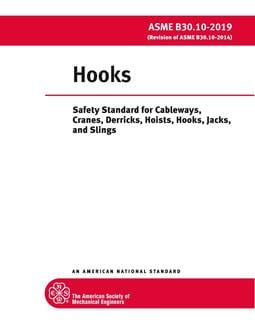
ASME B30.10-Hooks, 2024

ASME B30.10-Hooks, 2024

Book Overview
The ASME B30.10-Hooks, 2024 is the latest edition of the safety standard that governs the use, inspection, fabrication, and maintenance of hooks used in load‑handling equipment such as cranes, hoists, jacks, cableways, slings, etc. It is part of the larger ASME B30 series which covers various lifting and rigging equipment. This volume is specifically concerned with hooks: their safe design and capacity, how they are to be marked, how they should be inspected, repaired or replaced, and how users should operate them to avoid failure. One of the key updates in 2024 clarifies identification/marking requirements of hooks, especially concerning the hook manufacturer and the equipment manufacturer’s identification and the rated load markings.
Key aspects:
Scope & Definitions
- ASME B30.10 covers two classes of hooks:
- • Hooks that support a load in the “base” (bowl, saddle, or pinhole) of the hook (Chapter 10‑1).
- • Hooks that do not support a load in the base (i.e., non‑base loaded hooks) (Chapter 10‑2).
- Definitions include what is meant by rated load, proof test, proof load, normal service, design factor, etc.
Fabrication and Materials:
- Requirements for how hooks are made, the materials used, forging, casting, permissible repairs or modifications, and ensuring that strength and fatigue capacity are preserved.
Use, Maintenance, and Operation:
- Guidelines for safe usage: making sure the load is centered, avoiding side loads, ensuring latches are used if applicable, avoiding overloading, and following manufacturer’s or qualified persons’ instructions.
Inspection, Repair & Removal Criteria:
- Detailed rules for inspecting hooks: frequent visual inspections, periodic full inspections, criteria for removing hooks from service (cracks, deformation, wear beyond limits, missing identification, etc.). Repairs must be done only in ways permitted by the standard or manufacturer, and only by qualified persons.
Personnel Competence:
- The standard defines who is competent to inspect or repair hooks and who can make decisions about reuse or retirement of hooks. It addresses training and qualifications.
Highlights:
Identification / Marking:
- One of the 2024 changes: the standard now requires that either the hook manufacturer’s ID or the equipment manufacturer’s ID along with the rated load must be forged, cast, or die‑stamped on a low‑stress, non‑wearing area of the hook. Notably, the actual rated load (numeric value) need not be present, but the hook rated load identification must be preserved.
Effective Date & Compliance:
- The 2024 standard is set to become mandatory for equipment manufactured after a defined effective date; existing equipment usage and maintenance must conform in accordance with the new requirements.
Key Features & Benefits
The ASME B30.10-Hooks, 2024 provides a complete and detailed set of requirements for the design, use, inspection, marking, maintenance, and repair of hooks used in load-handling systems such as cranes, hoists, slings, and derricks. It is one of the most critical volumes in the B30 series, aimed at ensuring safety and reliability in lifting operations where hooks are a primary load-bearing component. This 2024 edition updates and clarifies previous rules, particularly concerning identification markings, inspection intervals, and removal criteria, reflecting evolving best practices and feedback from industry users.
Types of Hooks Covered
- Base-loaded hooks (load applied to the saddle or bowl of the hook)
- Non-base-loaded hooks (load applied outside the hook bowl, such as side loads)
- Both forged and cast hooks used in lifting applications
Design and Fabrication
- Materials, manufacturing methods, and stress considerations
- Prohibited modifications unless specified by the manufacturer
- Proper latching mechanisms and structural integrity guidelines
Identification and Marking Requirements
- New 2024 clarification: either the hook manufacturer’s ID or equipment manufacturer’s ID must be marked
- The rated load must be identified, though not necessarily numerically shown
- Markings must be on low-stress, non-wearing areas and remain legible throughout service life
Inspection Criteria
- Frequent inspections (daily or before each shift) for visible damage or wear
- Periodic inspections by a qualified person based on service conditions
- Criteria for removal from service, such as cracks, deformation, corrosion, or wear
Repair and Reuse
- Repairs allowed only under manufacturers or qualified person’s instructions
- Welding or reshaping only permitted when compliant with defined processes
- Repaired hooks must be re-inspected and retested if necessary
Use and Operational Practices
- Load must be centered in the hook bowl — side loading is not permitted unless rated for it
- Avoid shock loading or exceeding rated capacities
- Hooks must be used in conjunction with properly sized slings and lifting devices
Competence and Training
- Requirements for personnel qualification to inspect, operate, and maintain hooks
- Responsibility assignments for inspection frequency and approval for reuse
Applicability and Implementation
- Applies to all new and existing hooks in load-handling applications
- Mandatory compliance for equipment manufactured after the effective date
- Intended for use by manufacturers, inspectors, operators, engineers, and safety personnel
The ASME B30.10-Hooks, 2024 is practically applied across industries where lifting and rigging operations are essential—such as construction, manufacturing, shipping, mining, energy, and heavy equipment maintenance. It ensures that hooks, one of the most critical components in load-handling systems, are safely used, properly maintained, and reliably inspected to prevent failure during lifting operations. By incorporating ASME B30.10-2024 into daily practice, organizations reduce the risk of catastrophic lifting failures, protect personnel, and ensure legal and regulatory compliance.
Practical Uses in the Field:
Daily Operations
- Operators apply B30.10 rules to confirm the correct type of hook is used for the load and conditions.
- Pre-use inspections help identify damage, cracks, or deformation before lifting begins.
Maintenance & Inspection Programs
- Safety teams use the frequent and periodic inspection schedules outlined in the standard to maintain operational safety.
- Defined removal-from-service criteria ensure damaged hooks are taken out of circulation before failure.
Repair and Reuse Practices
- Maintenance staff follow strict rules about who may repair hooks and how, including when welding or reshaping is permitted.
- Hooks that are repaired must be re-inspected and tested, as per the standard, before returning to service.
Training and Competency
- Employers use the standard to train personnel on proper hook usage, identification, and inspection techniques.
- Ensures that only qualified individuals make decisions regarding hook integrity and continued use.
Marking and Traceability
- B30.10’s updated 2024 requirements help manufacturers and users ensure that hooks are properly identified by manufacturer or rated load, ensuring traceability in the field.
Regulatory Compliance
- Helps facilities pass safety audits and comply with OSHA, MSHA, or insurance inspections by following a nationally recognized safety standard.
The ASME B30.10-Hooks, 2024 is a critical reference for professionals pursuing certifications or licenses in rigging, crane operation, mechanical inspection, or lifting equipment safety. Mastering its content is essential for passing written exams, practical evaluations, and maintaining safety compliance in the field.
How ASME B30.10-2024 Supports Exam Preparation:
Fundamental Knowledge of Hook Safety
- Understand the types of hooks (base-loaded and non-base-loaded) and their specific applications.
- Learn the design, fabrication, and material standards for load-handling hooks.
Identification & Marking Requirements
- Memorize updated 2024 marking rules, such as the required presence of manufacturer or equipment ID and rated load identification.
- Recognize how improper markings can lead to removal from service.
Inspection and Maintenance Requirements
- Learn the difference between frequent and periodic inspections, including who is qualified to perform them.
- Identify removal criteria, such as cracks, excessive wear, deformation, or corrosion.
Repair and Reuse Guidelines
- Understand when and how a hook can be repaired or reshaped, and what documentation or testing is required before reuse.
Prohibited Practices
- Know operational do’s and don’ts, such as avoiding side loading, shock loading, or modifying hooks without approval.
Terminology and Definitions
- Familiarize yourself with key terms like rated load, proof test, design factor, and normal service—often used in exam questions.
Scenario-Based Problem Solving
- Prepare to evaluate real-world situations, like deciding whether a hook with visible wear should be removed from service or re-certified.
The ASME B30.10-Hooks, 2024 includes and supports a range of visual and organizational tools. These tools help professionals—from riggers to inspectors—quickly assess compliance, identify hazards, and maintain accurate records, all while aligning with the standard’s safety requirements.
Inspection Checklists
- Step-by-step checklists for frequent and periodic inspections.
Includes criteria such as:
- Deformation or cracks
- Missing or illegible markings
- Latch functionality
- Excessive throat opening or wear
Marking & Identification Guides
- Visual examples showing correct and incorrect hook markings.
Illustrations highlight:
- Manufacturer or equipment ID placement
- Location for rated load info
- Areas to avoid marking (e.g., high-stress zones)
Hook Geometry Diagrams
- Technical drawings of hook types (base-loaded vs. non-base-loaded).
- Dimension callouts for wear limits and opening deformation thresholds.
Decision Trees
Flowcharts for making decisions such as:
- “Can this hook be returned to service?”
- “Should this hook be removed, repaired, or replaced?”
Record-Keeping Templates
Forms for logging:
- Hook inspections (date, inspector, results)
- Repairs or replacements
- Compliance with periodic inspection intervals
Training Visuals
Diagrams and photos used in:
- Operator and inspector training sessions
- Toolbox talks and safety briefings
Non-Compliant Hook Examples
Visual references of damaged or non-compliant hooks:
- Hooks with side loading damage
- Hooks with worn-out latch mechanisms
- Illegible or missing markings
Book Details
- Publisher: American Society of Mechanical Engineers (ASME)
- Edition/Release Date: 11th Edition, July 28, 2025
- ISBN: 9780791876930
- Pages: 29
- Dimensions: 8.5 x 11 inches
- Format: Paperback / Softbound
- Target Audience: Professionals
Pricing & Purchase Information
• Price: $125.99
• Shipping: Free shipping on orders over $250.
• Formats Available: Physical Book
Related Products