
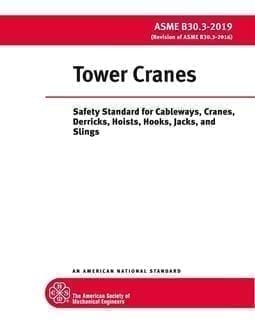
ASME B30.3-2019

ASME B30.3-2019

Book Overview
The ASME B30.3-2019 is a North American consensus safety standard that specifically addresses tower cranes, defining requirements for design, construction, installation, operation, inspection, maintenance, and testing. Below is a detailed description of what it covers, its scope and key provisions.
Key aspects:
- Applicability. The standard applies to construction tower cranes and permanently mounted tower cranes that are powered by electric motors or internal combustion engines.
- Operating Radius Adjustment. It covers cranes that adjust their operating radius via a luffing boom mechanism, a trolley running along a horizontal jib, or a combination.
- Mounting and Tower Support Arrangements. Cranes may be mounted on fixed bases or traveling bases. It also includes tower and supporting structures that allow the crane to “climb” within a building under construction or to have its tower height increased as the structure rises.
- Exclusions. Mobile cranes with tower‐type attachments are excluded (see ASME B30.5), as are self‐erecting tower cranes (covered by ASME B30.29).
- Lifting Operations. The safety requirements apply only when such cranes are used in lifting operations.
Highlights:
- Responsibilities section added: The 2019 edition introduces more explicit statements about the responsibilities of various parties (owner, user, manufacturer, erector, operator, maintenance personnel). This helps clarify who needs to do what for safety.
- Operation near power lines: There are new sections that address safe operation in proximity to both energized and de‑energized power lines. Requirements include how close parts can be, what precautions, warning signs, etc.
- Alignment with EN 14439 on strength & stability: The 2019 version brings its strength and stability clauses more in line with the European standard EN 14439. This may affect load chart design, structural safety margins, and how stability under combinations of loads is ensured.
- Scope exclusions clarified: Mobile cranes with tower attachments (per B30.5) and self‑erecting tower cranes (per B30.29) remain excluded. So always check whether your crane is under B30.3 or another volume.
Key Features & Benefits
The ASME B30.3-2019 provides an all-encompassing safety standard for tower cranes, covering every critical aspect from design and construction to operation, inspection, and maintenance. It defines the scope of tower cranes included, clarifies stakeholder responsibilities, and sets detailed requirements to ensure structural integrity, stability, and safe functioning under various conditions. The standard outlines procedures for crane erection, dismantling, and climbing, incorporates safety device mandates, and emphasizes the importance of operator training and competence. Additionally, it prescribes thorough inspection, testing, and maintenance protocols, as well as guidelines for marking, documentation, and safe operation near hazards like power lines and under environmental influences such as wind. This comprehensive approach ensures safe and reliable tower crane use throughout their lifecycle.
- Scope and application: Types of tower cranes covered and exclusions.
- Definitions and terminology: Clear and consistent language for the standard.
- Responsibilities: Safety duties of owners, users, operators, manufacturers, and maintenance personnel.
- Design and construction: Structural strength, stability, and load rating requirements.
- Installation and erection: Procedures for safe assembly, climbing, and height adjustments.
- Operational requirements: Safe load handling, radius control, operator controls, and hazard avoidance.
- Safety devices: Overload protection, limit switches, boom stops, and emergency controls.
- Inspection and testing: Types, frequency, and methods of inspection and load testing.
- Maintenance: Scheduled upkeep, repairs, and record-keeping.
- Operator qualifications: Training, certification, and competence requirements.
- Marking and documentation: Load charts, capacity labels, and safety warnings.
- Environmental factors: Considerations for wind, temperature, and site conditions.
- Emergency procedures: Guidelines for shutdown and hazard response.
The ASME B30.3-2019 serves as a vital framework for ensuring the safe and efficient use of tower cranes in construction and industrial settings. In practical terms, it guides crane manufacturers in designing and building equipment that meets rigorous safety and performance standards. For contractors and site managers, the standard provides clear procedures for proper crane installation, erection, and height adjustments, ensuring structural stability throughout a project. Operators rely on the standard’s operational rules, safety device requirements, and training guidelines to conduct lifting tasks safely while avoiding hazards like power lines or adverse weather. Maintenance teams use the inspection and testing protocols to identify wear, damage, or faults before they lead to accidents. Overall, ASME B30.3-2019 is essential for minimizing risks, preventing equipment failure, and protecting personnel during every phase of tower crane use.
- Manufacturer use: Designing and building tower cranes to meet structural and safety requirements.
- Installation crews: Following erection and climbing procedures to safely assemble and adjust crane height.
- Crane operators: Using safe operating practices, load charts, and controls to handle loads without exceeding limits.
- Site safety managers: Enforcing proximity restrictions to hazards such as power lines and ensuring compliance with environmental conditions.
- Inspection teams: Conducting frequent and periodic inspections, load tests, and maintenance to keep cranes in safe working condition.
- Training coordinators: Providing operator training and certification to ensure competent crane operation.
- Maintenance personnel: Performing scheduled upkeep and repairs based on standard guidelines to prevent failures.
- Project planners: Incorporating crane safety considerations in construction sequencing and risk assessments.
The ASME B30.3-2019 is a foundational resource that provides the technical knowledge and safety principles needed to demonstrate competence for individuals preparing for licensing exams or certification in tower crane operation. Exam candidates must understand the standard’s requirements for crane design, operation, load handling, and safety device functions. Familiarity with inspection protocols, maintenance schedules, and emergency procedures is also essential. The standard’s detailed coverage of operator responsibilities and safe practices ensures candidates are prepared to manage risks effectively. Studying ASME B30.3-2019 equips candidates to answer both theoretical and practical questions about tower crane safety, helping them meet the regulatory standards required to become certified crane operators or safety inspectors.
- Scope and applicability: Know which cranes fall under ASME B30.3 and which do not.
- Key definitions: Understand terminology such as boom, jib, climbing, load radius, etc.
- Crane components and design: Basics of structural parts and their safety requirements.
- Load charts and ratings: Interpretation and application during operations.
- Operating procedures: Safe load handling, boom positioning, and radius control.
- Safety devices: Functions and purpose of limit switches, overload protection, boom stops.
- Inspection types and frequency: Recognize what inspections are required and when.
- Maintenance standards: Understand the importance of scheduled upkeep and record-keeping.
- Operator responsibilities: Knowledge of communication, signals, and hazard avoidance.
- Emergency protocols: Procedures for shutdowns and responding to unsafe conditions.
- Environmental considerations: Effects of wind, power lines, and site conditions on safe operation.
- Training and competency: Requirements for operator qualifications and ongoing education.
To effectively navigate and implement the ASME B30.3-2019 standard, visual and organizational tools play a crucial role in simplifying complex information and enhancing comprehension. Flowcharts outlining inspection and maintenance schedules can help operators and maintenance teams follow required procedures systematically. Diagrams of tower crane components and load radius charts provide clear visual references to understand crane mechanics and safe operating limits. Checklists based on the standard’s requirements support thorough pre-operation inspections and safety audits, ensuring no critical steps are missed. Additionally, training materials that incorporate infographics and step-by-step guides assist in operator education, reinforcing key concepts like safety device functions and emergency protocols. Overall, these tools help transform the dense technical content of ASME B30.3-2019 into practical, easy-to-follow resources for diverse users.
- Flowcharts: Visualize inspection, testing, and maintenance sequences for routine compliance.
- Component diagrams: Illustrate crane parts like tower, boom, jib, hoist, and safety devices.
- Load radius/load charts: Graphical charts that define safe operating limits at various boom angles and radii.
- Checklists: Structured lists for pre-operation, periodic inspection, and maintenance tasks.
- Safety signage visuals: Examples of required markings, labels, and hazard warnings for quick reference.
- Step-by-step guides: Clear instructions for erection, dismantling, and climbing operations.
- Infographics: Summarize operator responsibilities, emergency procedures, and control functions.
- Training slides and videos: Multimedia tools to support operator certification and refresher training.
- Record-keeping templates: Organized logs for inspections, repairs, and maintenance history.
Book Details
- Publisher: American Society of Mechanical Engineers (ASME)
- Edition/Release Date: August 19, 2020
- ISBN: 9780791873410
- Pages: 56
- Dimensions: 8.5 x 11 inches
- Format: Paperback / Softbound
- Target Audience: Professionals
Pricing & Purchase Information
• Price: $117.99
• Shipping: Free shipping on orders over $250.
• Formats Available: Physical Book
Related Products