
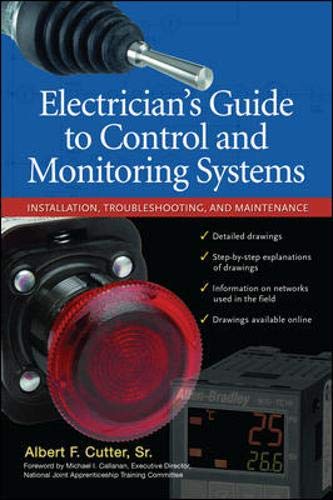
Electrician’s Guide to Control and Monitoring Systems

Electrician’s Guide to Control and Monitoring Systems

Book Overview
The Electrician’s Guide to Control and Monitoring Systems provides a thorough, practical introduction to control and monitoring systems for electricians, maintenance technicians, and contractors. Cutter, a veteran electrician with over 40 years of experience, presents complex control‑system concepts in an accessible, jargon‑free format. The text focuses primarily on installation, troubleshooting, and maintenance of networked monitoring and control systems—including ladder diagrams, input and output devices, and communications networks. Detailed drawings and step‑by‑step explanations help the reader interpret ladder diagrams and wiring layouts, breaking down the symbols and logic used in control systems. Coverage also extends to monitoring systems and networked devices: chapters explore programmable logic controllers (PLCs), communication standards such as RS‑232 and RS‑485, Modbus protocols, Ethernet, and USB connections—all within a practical context for electricians working in the field. Importantly, the book includes references to the National Fire Protection Association (NFPA) “2008 National Electrical Code (NEC)” articles where relevant, tying the content to recognized safety and code standards. This makes the guide suitable not only for learning about control‑ and monitoring‑systems wiring but also for on‑the‑job reference and maintenance‑work guidance. It’s particularly aimed at electrical contractors, field electricians, and maintenance personnel who encounter control panels, sensors, relays, PLCs and network interfaces in industrial or commercial installations.
Key aspects:
- Focuses on installation, troubleshooting and maintenance of control and monitoring systems—especially relevant for electricians and maintenance technicians.
- Explains how to read and interpret ladder diagrams and other control‑system drawings—symbols, logic and wiring explained step‑by‑step.
- Covers input devices, output devices, and networked monitoring systems including PLCs, RS‑232/RS‑485/Modbus, Ethernet and other field‑net communications.
- Includes code references (specifically to the 2008 edition of the National Electrical Code) and emphasizes practical compliance in control & monitoring applications.
- Richly illustrated with hundreds of product photos, line drawings, and online downloadable drawings to support the text visually.
Highlights:
- Written by a seasoned electrician (40+ years) with hands‑on experience in control systems—bringing practitioner insight into the book.
- Breaks down complex diagrams into digestible parts: ladder diagrams are “rebuilt” to show you how they function.
- Designed as a field‑use handbook (not just academic)—very much aimed at contractors and maintenance professionals.
- Additional downloadable drawings from the publisher enable deeper practice beyond the printed pages.
- Clear format and minimal “jargon” focus, making it more accessible to those who may be more field‑oriented than academically grounded.
Key Features & Benefits
The Electrician’s Guide to Control and Monitoring Systems provides electricians and maintenance technicians with an in‑depth look at modern control and monitoring systems, covering everything from basic ladder logic diagrams and input/output devices to networked communications protocols and maintenance strategies. Written by a veteran trade electrician, the book begins by breaking down ladder diagrams—showing how they are constructed, how symbols are used, and how the logic flows. It then moves into input devices (push buttons, switches, sensors), output devices (relays, starters, timers), and the infrastructure for monitoring systems including PLCs, RS‑232/RS‑485 networks, Modbus, Ethernet and USB interfaces. Installation procedures, wiring practices, and troubleshooting techniques are thoroughly explored. The guide also ties everything back to real‑world service and maintenance: how to interpret drawings, how to service and maintain control panels, and how to apply relevant code references (notably the National Fire Protection Association (NFPA)‑based wiring guidelines) when working in commercial and industrial monitoring systems. Illustrations and downloadable drawings support the text, helping users visualize the systems they’re working on and gain confidence in applying their skills in the field.
- Introduces ladder diagrams, explaining symbols, logic flow and wiring layouts.
- Explains key input devices (push buttons, switches, sensors) and how they interface in control systems.
- Covers important output devices: relays, starters, timing relays, solid‑state devices and three‑phase motor controls.
- Examines monitoring systems and networks: PLCs, modules, RS‑232/RS‑485, Modbus, Ethernet, USB, and backend monitoring hardware.
- Guides the reader through installation, troubleshooting and maintenance of control/monitoring systems in real‑world settings.
- Provides visual and supplemental support: detailed drawings, step‑by‑step wiring graphics, and online downloadable resources.
- Relates content to applicable code references (e.g., the 2008 NEC®) and practical compliance concerns in control/monitoring wiring.
- Designed for use as both a training text and an on‑the‑job reference for electricians working with control and monitoring systems.
The Electrician’s Guide to Control and Monitoring Systems places heavy emphasis on practical application for electricians, maintenance technicians, and contractors working with control and monitoring systems. It walks readers through the hands‑on tasks of interpreting ladder diagrams, wiring input and output devices, and integrating network communication systems within control panels. Installation, troubleshooting and maintenance are central to the narrative: for example, each chapter builds foundational knowledge (symbols, logic) and then transitions to field‑level application (wiring the devices, understanding network protocols, identifying faults). The book uses detailed drawings and step‑by‑step explanations to help the reader apply the material in real‑world settings—such as installing a motor starter control circuit or diagnosing a fault in a monitored control network. By focusing on worksite realities rather than deep theory, this text serves as a bridge between concept and job‑site practice.
- Step‑by‑step explanations of how control logic translates into wiring and field implementation.
- Real‑world focus: written by a seasoned electrician, with tools, device examples and field‑tested practices.
- Essential for contractors and maintenance personnel who need to apply control/monitoring systems instead of purely studying them.
- Lightweight technical sophistication—accessible to working professionals who need quick application rather than academic theory.
- Covers installation tasks of control systems: reading diagrams, wiring input/output devices, and integrating components.
- Focuses on troubleshooting and maintenance of control/monitoring systems, not just design.
The Electrician’s Guide to Control and Monitoring Systems is primarily focused on installation, troubleshooting, and maintenance of control and monitoring systems, it also supports electricians preparing for licensing exams by building key competencies that are often tested. It helps readers develop fluency in reading ladder diagrams, interpreting system logic, understanding input/output devices, and navigating networked control systems—all of which can appear in licensing or certification contexts. The book provides many detailed drawings, step‑by‑step breakdowns of wiring logic, and online downloadable material to reinforce visual learning. Although it isn’t a full‑scale journeyman/master electrician exam‑prep guide, the depth of its coverage of control systems strengthens the reader’s technical foundation and supports exam readiness in areas such as system interpretation, control wiring, and logic troubleshooting.
- Supports development of diagram interpretation and logic analysis—skills often required on electrician licensing tests.
- Provides detailed explanations of input/output devices, control panels, and wiring systems which bolster exam readiness.
- Includes ladder diagrams and control logic walkthroughs—useful for exams that test wiring logic or control systems knowledge.
- Offers many detailed drawings and downloadable resources to enhance visual and hands‑on learning.
- Although not a dedicated licensing exam‑question book, it strengthens technical competencies in control systems that may appear in specialized exam sections.
- Useful for electricians, apprentices, or maintenance technicians seeking to deepen their understanding of control systems ahead of certification.
The Electrician’s Guide to Control and Monitoring Systems is equipped with strong visual and organizational features designed to help electricians and maintenance technicians quickly understand and apply control and monitoring system concepts. It uses detailed drawings and line diagrams, many of which are broken down step‑by‑step to explain how ladder logic works, how input/output devices are wired, and how networks such as RS‑232/RS‑485 and Ethernet are integrated. Each page is organized to facilitate job‑site use: for instance, diagrams are paired with explanations, devices are shown with real‑world photos, and the text avoids heavy jargon in favor of direct labeling and visual cues. The book also offers online downloadable drawings for further study and practice. Appendices contain control symbols, ladder diagrams and device modules to support quick lookup. These features make the book both a training text and a practical reference that supports visual learning, self‑study, and field work.
- Enhanced with detailed drawings and step‑by‑step diagrams to illustrate ladder logic and control wiring.
- Includes hundreds of product photos and line drawings of input devices, output devices, sensors, and network modules.
- Features clear organization: each chapter covers a device or system type, with visuals paired with labeling and explanation.
- Provides online downloadable drawings and resources to supplement printed material.
- Jargon‑free layout and strong visual focus, making it accessible for both apprentices and experienced technicians.
- Structured to serve both as a learning tool and a field reference, with visuals that support quick access in job‑site settings.
Book Details
- Publisher: McGraw‑Hill Education
- Edition/Release Date: 1st Edition, April 14, 2010
- ISBN: 9780071700610
- Pages: 208
- Dimensions: 5.90 × 8.90 inches
- Format: Paperback / Softbound
- Target Audience: Professionals
Pricing & Purchase Information
• Price: $49.99
• Shipping: Free shipping on orders over $250.
• Formats Available: Physical Book
Related Products


Student Reviews
There are no contributions yet.