
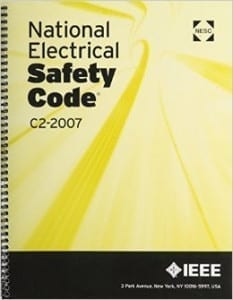
National Electrical Safety Code – 2007

National Electrical Safety Code – 2007

Book Overview
The National Electrical Safety Code – 2007 is published exclusively by the IEEE, the 2007 NESC is the single most important document for safeguarding persons against electrical hazards during the installation, operation and maintenance of electric supply and communication lines. More importantly, it contains extensive updates and critical revisions that directly impact the power utility industry. Adopted by law by the majority of states and Public Service Commissions across the US, the NESC is a performance code considered to be the authoritative source on good electrical engineering practice, for over 90 years. This standard covers basic provisions for safeguarding persons from hazards arising from the installation, operation, or maintenance of 1) conductors and equipment in electric supply stations, and 2) overhead and underground electric supply and communication lines. It also includes work rules for the construction, maintenance, and operation of electric supply and communication lines and equipment. The standard is applicable to the systems and equipment operated by utilities, or similar systems and equipment, of an industrial establishment or complex under the control of qualified persons. This standard consists of the introduction, definitions, grounding rules, list of referenced and bibliographic documents, and Parts 1, 2, 3, and 4 of the 2007 Edition of the National Electrical Safety Code.
Key aspects:
- Worker Safety Requirements
- Clearance Standards
- Grounding and Bonding
- Pole and Structure Strength
- Installation and Maintenance Rules
- Energized Line Work
- Underground Systems Safety
- Communication Systems
- Environmental and Weather Considerations
- Compliance with Federal Standards
Highlights:
- Better Alignment with OSHA Regulations
- Improved Usability and Organization
- Updated Underground Installation Guidelines
- Clarification of Shared-Use Structures
- Expanded Worker Safety Rules
- Enhanced Arc-Flash Protection Requirements
Key Features & Benefits
The National Electrical Safety Code – 2007 offers broad and in-depth coverage of safety rules for the installation, operation, and maintenance of electric supply and communication lines. Developed by the IEEE, this code applies primarily to public and private utilities, covering everything from overhead line design to underground system protection. It provides essential requirements for safeguarding workers, the public, and equipment in all phases of electric and telecommunications infrastructure development. The 2007 edition updates key rules, aligns better with OSHA regulations, and introduces clearer guidelines for real-world utility operations. It is a core reference for engineers, utility personnel, inspectors, and safety managers.
Areas of Comprehensive Coverage:
Overhead Line Construction and Maintenance
- Minimum clearances over roads, buildings, and waterways
- Conductor spacing, sag, and tension specifications
- Guying and anchoring requirements
Underground System Standards
- Cable trenching, duct systems, vaults, and access enclosures
- Installation methods and protection against environmental hazards
- Separation between electric and communication lines
Worker Safety Requirements
- Arc-flash and shock protection
- PPE guidelines and minimum approach distances
- Training and job briefing expectations
Grounding and Bonding
- Requirements for system grounding and equipment bonding
- Ground resistance limits and conductor sizing
- Neutral grounding and surge protection considerations
Pole and Structural Loading
- Wind and ice loading specifications
- Pole strength analysis and structural stability
- Load factors and guying systems
Communication Line Installations
- Shared-use pole rules (joint use with power lines)
- Clearances between communication and electric lines
- Cable placement and tensioning standards
Inspection, Testing, and Maintenance
- Periodic inspection requirements for lines and equipment
- Testing procedures for grounding and protective devices
- Documentation and compliance tracking
Environmental and Climatic Design Considerations
- Adjustments for geographic and climatic variations
- Temperature-based conductor expansion and tensioning
- Special rules for coastal, high-altitude, and cold weather zones
Administrative Provisions and Compliance
- Definitions, scope, and applicability
- Cross-references to OSHA and related standards
- Guidance for rule interpretation and exceptions
The National Electrical Safety Code – 2007 is designed not only as a regulatory framework but also as a practical guide for real-world application in the design, construction, operation, and maintenance of electrical and communication systems. Its rules are used daily by engineers, lineworkers, utility planners, inspectors, and safety officers to ensure that power and telecom infrastructure is built and maintained safely and efficiently. Whether planning the installation of overhead transmission lines or working in underground distribution networks, professionals apply NESC rules to determine safe clearances, structural integrity, grounding practices, and worker protection measures. The code’s engineering tables, minimum approach distances, and equipment standards directly inform design decisions and on-site work procedures. Its detailed safety protocols help workers assess arc-flash risks, select PPE, and develop safe work practices that meet both utility policy and OSHA compliance.
Examples of Practical Application:
- Line Clearance Design
- Pole Strength Calculation
- Arc-Flash Protection Planning
- Grounding System Layout
- Shared-Use Infrastructure Coordination
- Underground Cable Installation
- Work Zone Safety Protocols
- Inspection and Maintenance Standards
The National Electrical Safety Code – 2007 plays a critical role in preparing professionals for licensing and certification exams in electrical utility work, safety compliance, and engineering. Many state and utility-level licensing exams reference the NESC as a core standard, especially for individuals involved in designing, installing, or maintaining high-voltage or communication systems. Professionals studying for these exams—such as power linemen certification, utility safety officer licensing, or engineering PE exams with electrical focus—must be able to interpret and apply NESC rules in real-world scenarios. The 2007 edition provides the legal and technical foundation for questions related to clearances, grounding, arc-flash protection, structural loading, and safety procedures.
Tips for Exam Prep with NESC 2007:
- Use the table of contents and index for fast navigation during open-book exams.
- Familiarize yourself with the structure of rules, notes, and exceptions.
- Practice interpreting figures, tables, and clearance diagrams.
- Review key updates introduced in the 2007 edition if exams test on version-specific content.
- Combine NESC with study guides, workbooks, or exam simulators tailored to your licensing area.
The National Electrical Safety Code – 2007 is structured to be both a regulatory reference and a practical guide, offering a logical layout and key visual elements that support clarity and usability—especially for engineers, field workers, and safety inspectors who rely on quick, accurate interpretations in high-stakes environments.
- Clear Rule Numbering System
- Well-Structured Code Sections
- Tables and Charts
- Detailed Diagrams and Figures
- Explanatory Notes and Appendices
- Defined Terminology and Glossary
- Cross-Referencing with OSHA and ANSI
Book Details
- Publisher: Institute of Electrical and Electronics Engineers (IEEE)
- Edition/Release Date: 2007 Edition, August 1, 2006
- ISBN: 9780738198286
- Pages: 373
- Dimensions: 8.5 × 11 inches
- Format: Spiralbound
- Target Audience: Professionals
Pricing & Purchase Information
• Price: $259.99
• Shipping: Free shipping on orders over $250.
• Formats Available: Physical Book
Related Products