
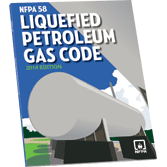
NFPA 58: Liquefied Petroleum Gas Code, 2014 Edition

NFPA 58: Liquefied Petroleum Gas Code, 2014 Edition

Book Overview
The NFPA 58 Liquefied Petroleum Gas Code is the industry standard for the safe storage, handling, transportation, and use of liquefied petroleum gas (LP-Gas) in various applications. It establishes safety requirements to mitigate risks such as leaks, fires, and explosions.
Key Areas Covered:
- Storage & Handling: Guidelines for proper containment to prevent leaks and accidents.
- Safety Equipment: Specifications for pressure regulators, valves, and other protective devices.
- Transportation: Regulations for safely transporting LP-Gas to minimize hazards.
- Installation & Operation: Standards for marine terminals and pipeline terminals that receive and distribute LP-Gas.
- Odorization: Requirements for adding odorants to LP-Gas to help detect leaks.
The latest edition of NFPA 58 includes updated safety measures, environmental considerations, and operational guidelines to ensure compliance and safe distribution. If you’re looking for training on NFPA 58, there are expert-led courses available to help professionals correctly apply its requirements.
Key Features & Benefits
NFPA 58, also known as the Liquefied Petroleum Gas Code, provides safety requirements for LP-Gas (propane) installations to protect homes, businesses, and industrial settings. It covers various aspects, including:
- Container construction and piping design
- Separation of containers from buildings
- Handling LP-Gas during transfer and storage
- Operator qualifications and pre-transfer inspections
- Fire-resistance rating and noncombustible materials
- Operations and maintenance requirements
The National Fire Protection Association 58: Liquefied Petroleum Gas Code (2014 Edition) provides practical, real-world guidance for safely handling, storing, transporting, and using liquefied petroleum gas (LPG), such as propane and butane. In everyday applications, it serves as a critical safety framework for industries, businesses, and residential users by minimizing fire, explosion, and leak hazards associated with LPG systems. The code is widely used by engineers, inspectors, fire marshals, and facility operators to design compliant installations, ensure proper equipment selection, and establish safe operating procedures. It also supports regulatory enforcement and insurance requirements, making it essential for maintaining public safety and operational reliability in environments ranging from homes with propane tanks to large-scale industrial gas systems.
Practical Applications:
- Residential Safety: Governs installation and placement of propane tanks, piping, and appliances in homes.
- Commercial Operations: Provides rules for LPG use in restaurants, hotels, and retail businesses (e.g., heating, cooking).
- Industrial Facilities: Guides bulk storage, transfer systems, and cylinder filling operations.
- Transportation: Sets requirements for transporting LPG cylinders and tanks safely by road or rail.
- Inspection & Compliance: Used by fire inspectors and authorities to enforce safety codes and prevent hazards.
- Emergency Response Planning: Helps first responders understand risks and proper procedures for LPG incidents.
- Agricultural Use: Applies to propane-powered equipment, crop drying, and heating systems on farms.
- Temporary Installations: Covers safe use of LPG at construction sites, events, and mobile operations.
Preparing for a licensing exam based on National Fire Protection Association 58: Liquefied Petroleum Gas Code (2014 Edition) involves developing a strong understanding of the code’s structure, key safety principles, and practical applications in real-world LPG systems. Candidates are typically tested on their ability to interpret code requirements, apply them to scenarios, and ensure compliance with installation, storage, handling, and transportation standards for liquefied petroleum gases. Effective preparation includes studying core chapters, practicing code navigation, and reviewing common exam topics such as container placement, system design, and emergency controls. Familiarity with definitions, tables, and exceptions is especially important, as exams often assess both knowledge and the ability to quickly locate and apply specific provisions within the code.
Licensing Exam Preparation Tips:
- Understand Code Structure: Learn how chapters, sections, and annexes are organized for quick reference.
- Focus on Key Topics: Study container installation, piping systems, regulators, and safety devices.
- Memorize Critical Tables: Pay attention to separation distances, pressure limits, and sizing charts.
- Practice Code Navigation: Use tabs or indexing to quickly locate information during open-book exams.
- Review Definitions: Know terminology used throughout the code to interpret questions correctly.
- Work Practice Questions: Apply code rules to real-life scenarios and sample exam problems.
- Study Safety Requirements: Emphasize fire prevention, leak control, and emergency shutoff procedures.
- Understand Exceptions & Notes: Exams often test knowledge of special cases and allowances.
- Use Official Resources: Reference NFPA handbooks, training materials, and study guides.
- Simulate Exam Conditions: Practice timing and answering questions under realistic constraints.
When working with National Fire Protection Association 58: Liquefied Petroleum Gas Code (2014 Edition), visual and organizational tools are essential for efficiently navigating the code and applying its requirements in both exam settings and real-world scenarios. Because the document is dense and highly structured, professionals rely on tabbing systems, color coding, charts, and quick-reference aids to locate critical information quickly and reduce errors. These tools help users interpret complex requirements—such as separation distances, container specifications, and piping rules—while improving speed and accuracy during inspections, design work, or licensing exams.
Visual & Organizational Tools:
- Tabbed Sections: Use physical or digital tabs to mark key chapters (e.g., storage, piping, transportation).
- Color Coding: Highlight different topics (e.g., red for safety, blue for installation, green for tables).
- Quick-Reference Sheets: Create condensed notes for frequently used tables and formulas.
- Flowcharts: Map procedures like system installation, leak testing, or emergency response steps.
- Tables & Charts Familiarity: Focus on commonly referenced tables (e.g., container distances, sizing).
- Index Utilization: Practice using the index to locate topics quickly during open-book exams.
- Margin Notes: Write brief explanations or reminders next to complex sections.
- Acronyms & Mnemonics: Develop memory aids for key rules and sequences.
- Cross-Referencing: Note related sections to understand how different requirements connect.
- Digital Search Tools: Use searchable PDFs or apps to quickly find keywords and code sections.
Book Details
- Publisher: NFPA
- Edition/Release Date: January 1, 2014
- ISBN: 9781455907113
- Pages: 133
- Dimensions: 8.5 x 1.25 x 11 inches.
- Format: Paperback
- Target Audience: Professional
Pricing & Purchase Information
• Price: $203.99
• Shipping: Free shipping on orders over $250.
• Formats Available: Physical Book
Related Products