
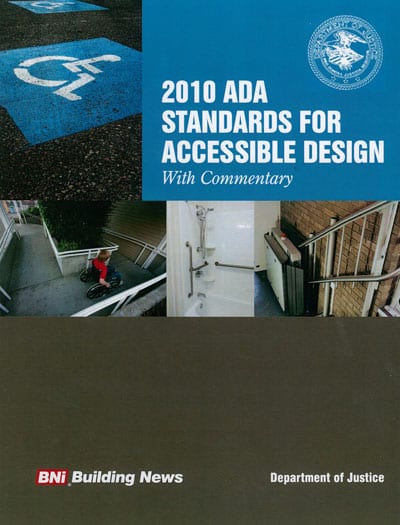
2010 ADA Standards for Accessible Design
$71.99
As of March 15, 2012 all public parks, hotels, country clubs, universities, restaurants, and even condominiums must comply with far-reaching 2010 ADA Standards. This volume presents the new 2010 Standards side-by-side with explanatory guidance and background.
2010 ADA Standards for Accessible Design

2010 ADA Standards for Accessible Design

Book Overview
- The 2010 ADA Standards for Accessible Design provide detailed scoping and technical requirements to ensure accessibility in newly designed, constructed, or altered facilities. These standards are organized into several chapters, each focusing on different aspects of accessibility:
- Chapter 1: Application and Administration
This chapter outlines the purpose and scope of the standards, specifying their applicability to various facilities and elements. - Chapter 2: Scoping Requirements
It defines the minimum number of accessible elements required in different types of facilities, ensuring that accessibility is integrated into the design and construction process. - Chapter 3: Building Blocks
This section provides technical requirements for elements such as accessible routes, doorways, and clear floor space, forming the foundation for accessible design. - Chapter 4: Accessible Routes
It specifies the requirements for continuous, unobstructed paths that connect all accessible elements within a facility, accommodating individuals with mobility impairments. - Chapter 5: General Site and Building Elements
This chapter addresses elements like parking spaces, curb ramps, and entrances, ensuring they are designed to be accessible to all users. - Chapter 6: Plumbing Elements and Facilities
It provides guidelines for accessible restrooms, drinking fountains, and other plumbing fixtures, focusing on usability for individuals with disabilities. - Chapter 7: Communication Elements and Features
This section covers requirements for visual and audible communication elements, such as signage and assistive listening systems, to accommodate individuals with sensory impairments. - Chapter 8: Special Rooms, Spaces, and Elements
It details accessibility requirements for specific areas like kitchens, laundry rooms, and recreational facilities, ensuring they are usable by individuals with disabilities. - Chapter 9: Built-In Elements
This chapter addresses built-in elements such as counters, shelves, and work surfaces, specifying their design to be accessible to all users. - Chapter 10: Recreational Facilities
It provides guidelines for accessible design in recreational areas, including play areas, swimming pools, and sports facilities, ensuring inclusivity in recreational spaces.
Key Features & Benefits
- The 2010 ADA Standards for Accessible Design are the enforceable accessibility requirements for new and altered public and commercial facilities, effective March 15, 2012. They cover both scoping (how many) and technical (how) provisions for a wide range of areas, including accessible routes, parking, restrooms, and recreational facilities. Key changes from previous guidelines include new children’s standards, specific requirements for transient lodging and medical facilities, and revised technical details for elements like ramps, elevators, and signage.
The 2010 ADA Standards for Accessible Design serve as a bridge between theoretical accessibility guidelines and their practical application in real-world settings. These standards are not just abstract concepts; they are meticulously crafted to address the complexities of diverse environments, ensuring that individuals with disabilities can navigate and utilize public and private spaces with ease.
The 2010 ADA Standards for Accessible Design are integral to various licensing exams and certifications in the architecture, construction, and accessibility fields. Professionals preparing for these assessments often rely on authoritative resources that interpret and illustrate these standards.
The standards include numerous figures and diagrams to illustrate dimensional requirements and relationships between building elements. For example, figures are used to visually explain:
- Clear floor space and turning space.
- Maneuvering clearances at doors.
- Slope and landing requirements for ramps and curb ramps.
- Dimensions and placement of grab bars.
Third-party publishers have created visual guides, such as ADA Illustrated, that provide realistic, context-specific illustrations of the standards. These tools help users visualize how the rules apply to real-world spaces like:
- Accessible bathrooms.
- Parking lots.
- Amusement park rides.
- Boating piers.
Book Details
- Publisher: U.S. Department of Justice (Author)
- Edition/Release Date: February 20, 2024
- ISBN: 979-8880280445
- Pages: 279 pages
- Dimensions: 8.5 x 0.63 x 11 inches
- Format: paperback.
Pricing & Purchase Information
• Price: $71.99
• Shipping: Free shipping on orders over $250.
• Formats Available: Physical Book
Related Products